
DESIGN ANSWERS
Every interior design project begins with questions. Below are answers to some of the ones we hear most often – about our process, our approach to design, and what it’s like to work with our studio. If you have a project on your mind, we would love to hear about it. Get in touch
What should I look for in a New York interior designer?
Look for someone hands-on, detail-oriented, and invested in your project from start to finish, not just at the presentation stage. A great designer should bring an architectural understanding of space, not just a talent for selecting furnishings. Ask how involved they’ll be day-to-day, how they handle contractor coordination, and whether they’ve managed projects at the scale you’re considering.
Our studio is based in New York City, and we work across Westchester, Greenwich, the Hudson Valley, the Hamptons, northern New Jersey, and well beyond. Our portfolio includes homes in Palm Beach, Florida, Bronxville, New York, Southhampton East Hampton, Jamestown, Rhode Island, and Great Falls, Virginia. For projects outside our immediate area, we partner with trusted local contractors to ensure the same standard of execution. The initial conversation is always a phone or video call, so distance is never a barrier to getting started.
How much does an interior designer cost?
The cost of an interior designer depends on the scope, level of customization, and scale of the project. It's important to be upfront about that from the start. Renovations exist on a spectrum, and so do design fees.
As a general framework, it's reasonable to expect that a designer who fully manages your project will add approximately 30% to the total cost of the work before design services. I take a lot of pride in the efficient spending of my clients' resources. The goal is to make sure every dollar is used well. Without that guidance, clients often spend more time and just as much money arriving at a result they're less satisfied with.
Redecorating is far less invasive-the focus is on furnishings, lighting, textiles, and accessories, which makes it easier to phase and scale. Our work ranges from decorating-only projects and furnishing programs to comprehensive, whole-home renovations. We welcome projects of varying scope, and we're transparent about fees from the beginning. If you know you want to make a change, don't wait too long— costs rarely go down, and the sooner you act, the longer you get to enjoy it.
What does working with an interior designer look like?
It starts with a real conversation, typically a phone or video call, where I get to know you, your home, and what you’re hoping to create. Not just the look, but how you actually live. If it feels like the right fit on both sides, we schedule a site visit. I ask a few key questions early on: how you use each room, what’s working and what isn’t, and how you want the space to feel.
My preference is to present a highly detailed, comprehensive design concept rather than showing options piecemeal. At our Bronxville project, a hand-painted de Gournay wallpaper in the dining room became the seed of inspiration for the entire home’s color palette. That’s the kind of decision that happens early and shapes everything that follows. When I present a complete vision including materials, furnishings, lighting, art, finishes, clients can respond to the whole picture instead of picking apart individual elements. That level of preparation means fewer revisions during construction and a smoother build overall.
What are the best wall finishes beyond paint?
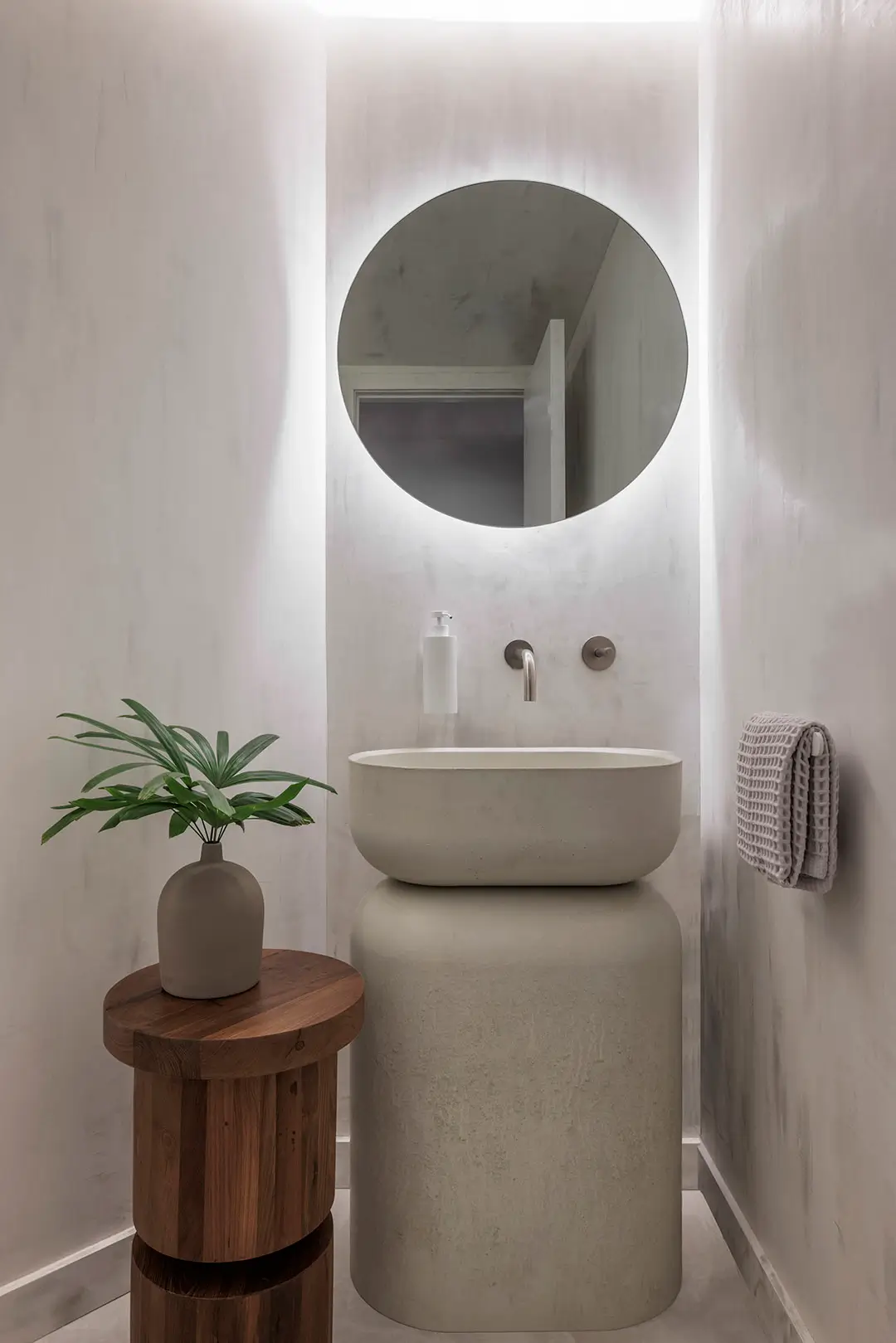
Standard paint is a starting point, but it’s far from the only option. We work with Venetian plaster, striated finishes, high gloss lacquer, micro-cement, and high-end wallcoverings—each one creates a different quality of depth and texture. We’re always looking for new and distinctive finishes to add to our repertoire and bring into our clients’ homes.
I’ve worked with the same painting professional for over 15 years on specialty finishes. At our Palm Beach project, we installed cream and gray Venetian plaster walls in the powder room, creating a calming quality you can’t achieve with flat paint. At Bronxville, the foyer ceiling was finished in ultra-high-gloss Wedgewood Blue lacquer, preserving the gorgeous French oak paneling while adding a layer of luminosity that transformed the entry. And in the same home, the attic office ceiling was wrapped in a vibrant pink lacquered paper. The finish on a wall or ceiling can be as architecturally expressive as the millwork around it.
How do designers use bold color without overwhelming a room?
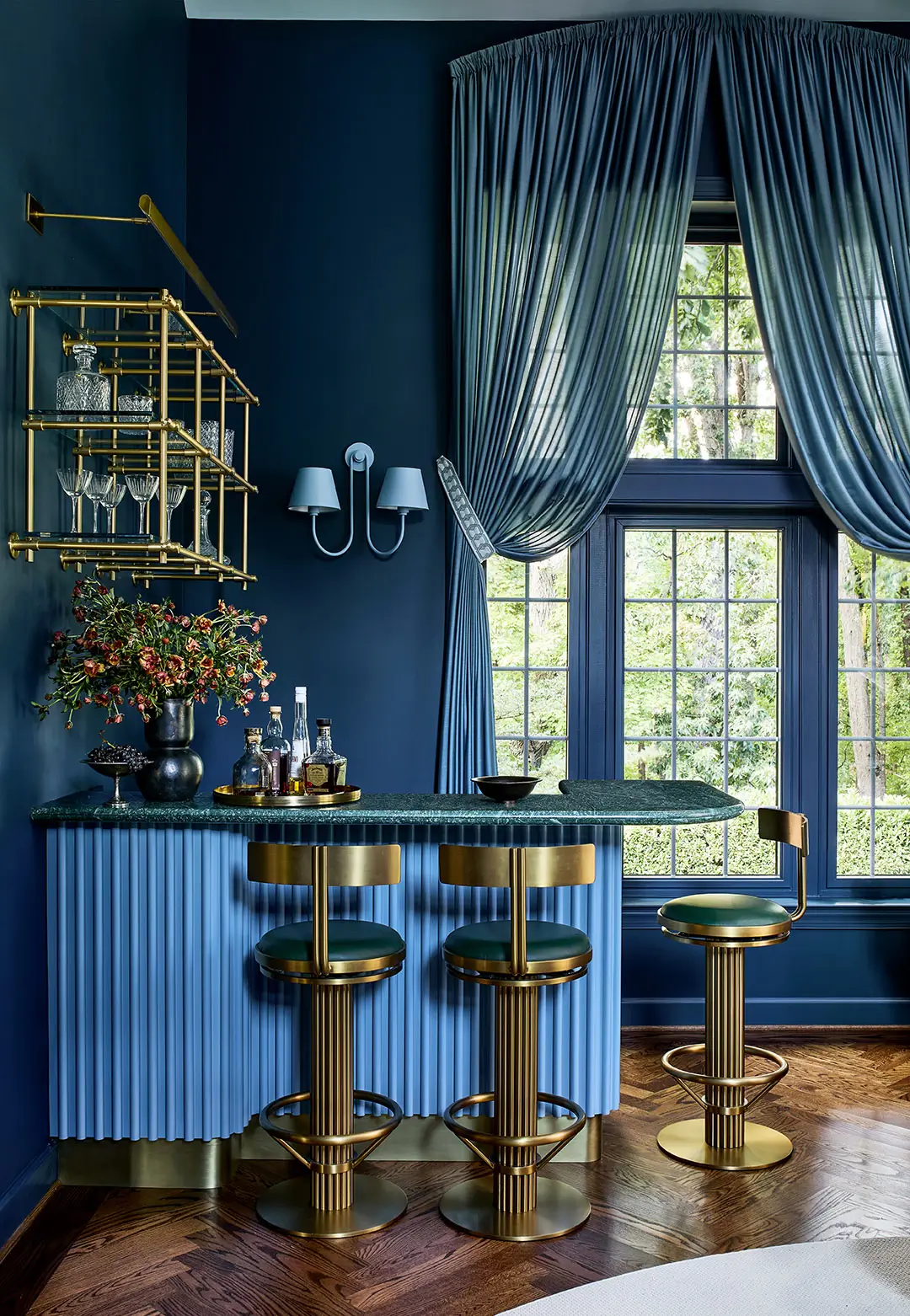
With intention. Bold doesn’t mean busy; saturated color often makes a space feel richer, not fuller. The key is knowing where to commit and where to pull back.
At our Bronxville project, each room has its own personality. For example, a jungle-scene wallpaper drives the dining room’s playful palette, jewel-toned fabrics in the living room play off the historic oak paneling, and the family room leans into deep blues. As I see it, people aren’t one-dimensional; their houses shouldn’t be either. At the Kips Bay Decorator Show House, the approach was different: one strong idea, fully committed to—three tones of teal in ultra-wide stripes at ultra-high gloss. Then at our Jamestown, Rhode Island home, the palette shifted entirely—soft lemons, ochres, and summer greens inspired by the feeling of being near water. Color should respond to the architecture and the life being lived in the space.
What does a full-service interior designer actually do?
Full-service means we’re involved in every decision that shapes your home, from the first conversation to the final styling. That includes space planning, architectural detailing, material and finish selection, custom millwork, furniture and lighting procurement, art consulting, contractor coordination, and installation oversight. Every project is highly customized, and we work across a range of scales and styles.
On a project like our Great Falls, Virginia residence—a 10,000-square-foot home with 34 rooms—that scope included gut-renovating six bathrooms and two kitchens, designing a home theater, converting underused spaces into purposeful rooms, and integrating an art collection featuring works by Keith Haring, Andy Warhol, and Harry Bertoia. But not every project is that scale. We also take on smaller engagements focused on furnishings, textiles, and finishing touches. The value of full-service is that the home feels like one vision, not a collection of separate decisions. When one firm oversees every element, the home tells a unified story. Nothing has to be precious. It just has to be considered.
How long does a home renovation take?
Generally, a year or more. A single-room project might take a few months, while a comprehensive renovation can extend to two or three years from the first design meeting to final installation. Our Great Falls residence took two years—it began as a casual conversation and grew into one of our largest engagements, spanning over 30 rooms. Once construction began, the interiors were completed within a year.
Several factors affect the timeline: the extent of construction, permitting, lead times for custom millwork and specialty finishes, and furniture procurement. When a project is well planned, the timeline becomes much easier on our clients, including how we address their living comfort during the process. There is a method to it, and we consider every aspect of their daily life throughout. My advice is always to start the conversation with a designer early. Even six months of lead time for design development makes a meaningful difference in the quality and pace of the result.
Is an interior designer worth it?
In most cases, yes. People often end up decorating around problems they’ll never fully be happy with. A designer helps you identify whether you need a foundational change or a visual refresh before you spend money on the wrong approach. That clarity alone can save significant time and cost.
At our Beekman Place townhouse project, the client was coming from an opulent, heavily ornamented Park Avenue apartment and wanted something entirely different: cleaner, more modern, but still honoring her collection of antiques. That’s the kind of transformation that requires a designer, not just to select new furnishings, but to rethink how a home works around the life being lived in it. We coordinate with contractors, tradespeople, and vendors so everything comes together both aesthetically and functionally. Our team ensures your investment goes further than it would on your own.
What is a high gloss lacquer finish?
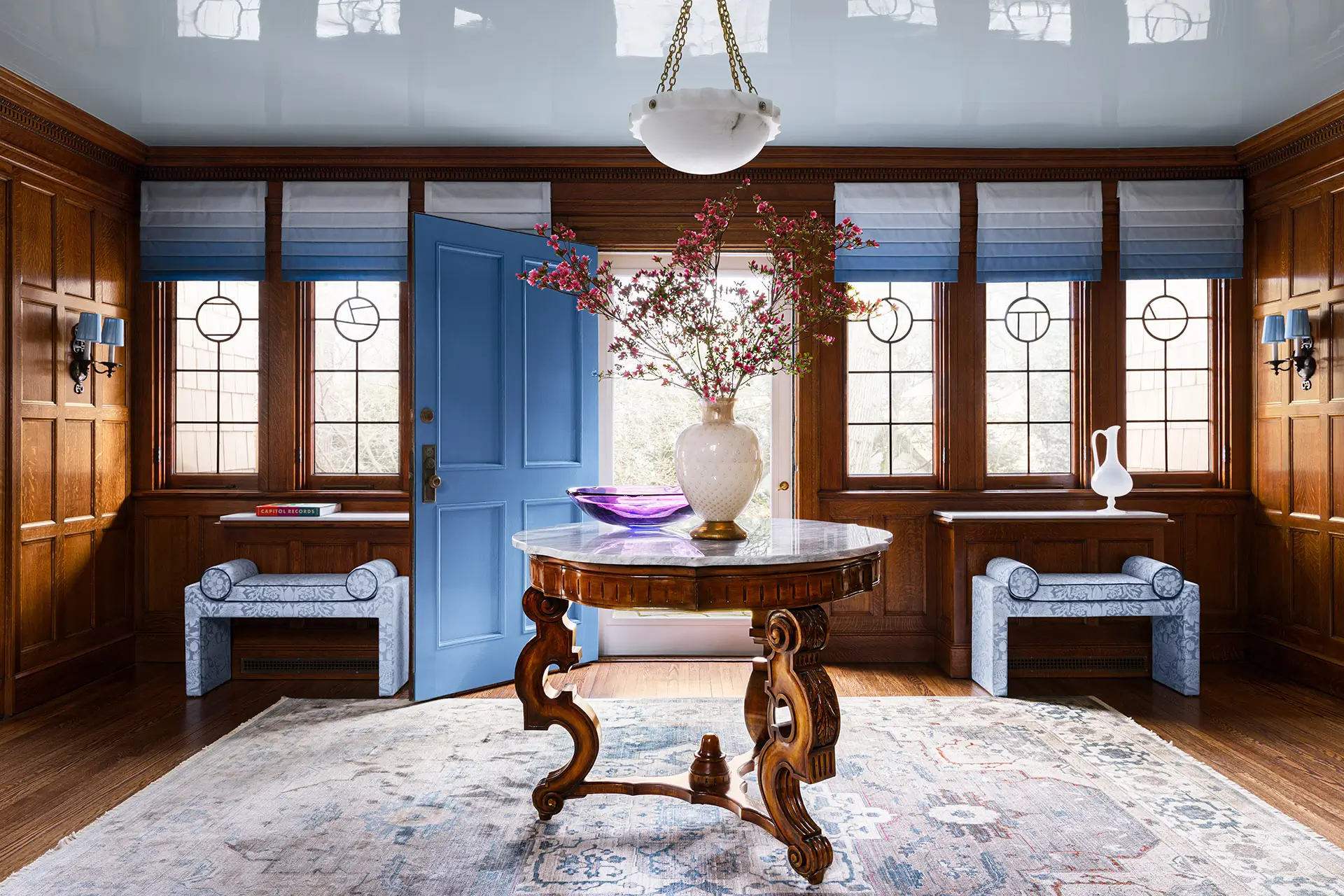
High gloss lacquer creates surfaces with remarkable depth and luminosity, almost like looking into still water. It’s one of the most striking finishes in interior design, and one of the most demanding. Every imperfection in the substrate is magnified, so the prep work and the painter’s skill matter enormously.
At the Kips Bay Decorator Show House, my painting professional executed a powder room in three tones of teal at ultra-high gloss; it earned the cover of the New York Times Home section. At our Bronxville project, lacquer appeared in two very different forms: a Wedgewood Blue on the foyer ceiling that preserved the French oak paneling while transforming the entry, and a vibrant pink lacquered paper on the sloped ceilings of the attic office. A space the client calls “feminine and powerful at the same time.” Lacquer works beautifully in ceilings, powder rooms, foyers, dining rooms, and home offices. The investment is higher than standard painting, but the effect is architectural.
How should I display an art collection in my home?
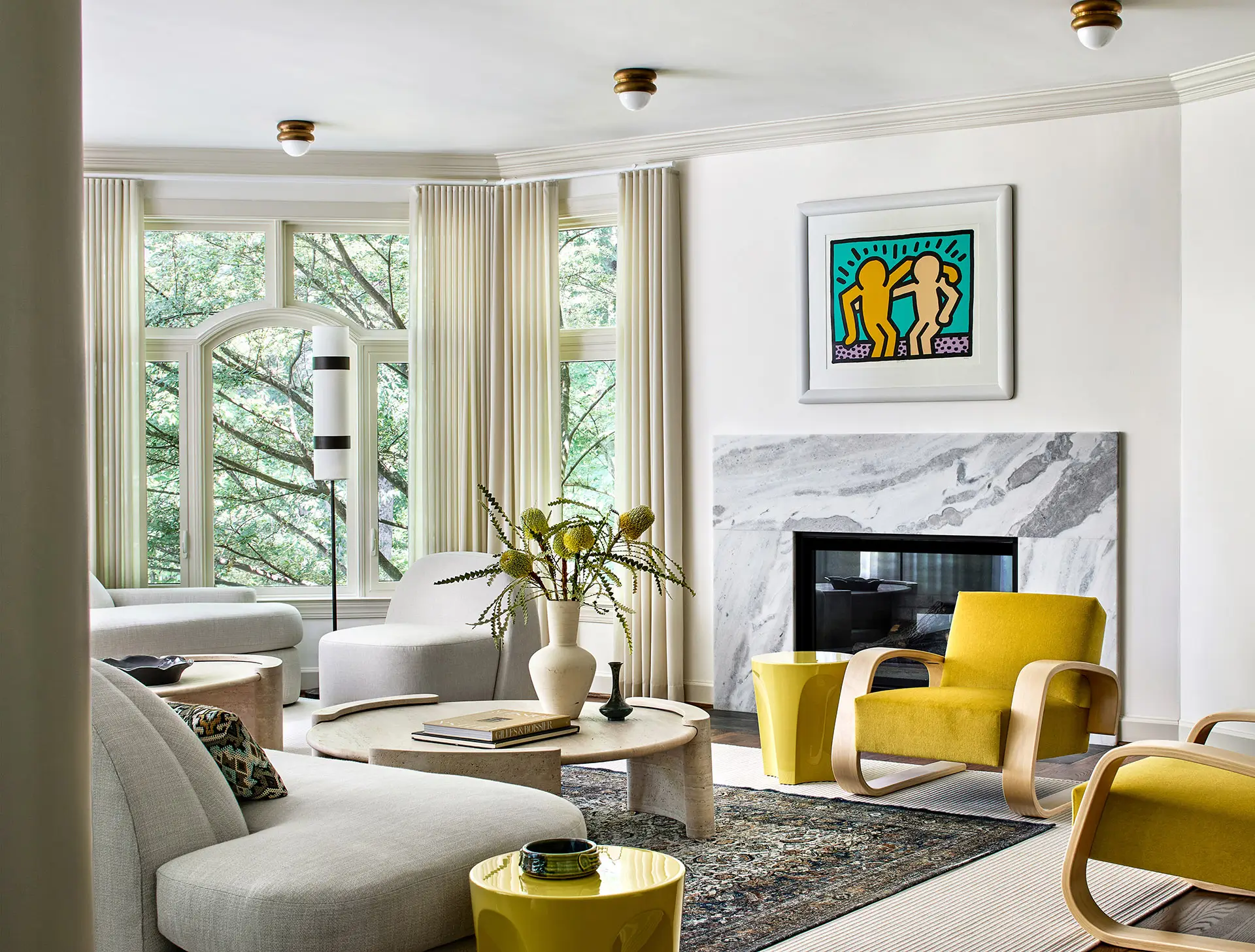
To display art effectively, you need to consider scale, lighting, context, and framing from the very beginning of the design process. Art should feel organic to a room, not like an afterthought pinned to a wall. Framing matters more than most people realize. The right frame anchors a piece in its room, while the wrong one can make even great art feel disconnected from the space around it.
At our Palm Beach project, the clients’ collection – Picasso, Frank Stella, Jasper Johns, Ellsworth Kelly – drove every design choice. I was asked to create a home first for the art and secondly for the clients. White walls, light furnishings, and a neutral palette allowed the work to take the spotlight, with each piece referencing and drawing attention to the others. At our Beekman Place townhouse, the approach was different: the client’s antiques and curated pieces, from gilded opera chairs to a Chagall-influenced painting, were woven into a modern context so each one could shine from a new perspective. In both cases, the art informed many key design decisions from the very start.
Should I renovate or redecorate?
It often comes down to desire and whether that desire can realistically be supported by budget and lifestyle. If someone truly wants a transformative change, better flow, improved functionality, or a level of finish that simply can’t be achieved with surface updates, I usually advocate for renovating if the numbers work. Otherwise, people end up decorating around problems they’ll never fully be happy with.
That said, redecorating is often the smarter choice. If the bones of a space work, many people discover they don’t actually dislike their home, but rather they dislike outdated finishes and poor lighting, and they may just need furniture to be reupholstered. New isn’t always better. At our Jamestown, Rhode Island project, the nineteenth-century shingled home had beautiful existing character. Instead of gutting it, we worked with what was there by amplifying the summer feeling of being near water with soft colors and an eclectic mix of mid-century and vintage elements. A renovation may be more than the doctor prescribed, which my clients can be happy to find out. A renovation makes sense when the goal is structural or foundational change, not just a visual refresh.
Every great home starts with a conversation. Whether you’re reimagining a single room or an entire home, we’d love to hear about it. Get in touch